Wow, a month has gone by and I finally got back to put up another post.
The corn is growing FAST now. The last half of June was, and always is, a very busy time period. During those two weeks we cultivated all the corn with our rolling cultivators, fertilized all the corn with liquid nitrogen using our coulter applicator, and ridged all the corn to prepare it for irrigation.
One step at a time. We use two 8-row cultivators that are adaptations of the Lilliston cultivator. they have curved spider wheels that run in the dirt, loosening the soil and throwing some soil onto the row, covering up small weeds next to the corn plants. They work best when you can travel about 6-7 mph. This is a picture of one of 16 gangs per cultivator.
The picture to the left is one of our ridgers. We run two like this and can convert one of the cultivators to ridging if needed. This year we needed it.
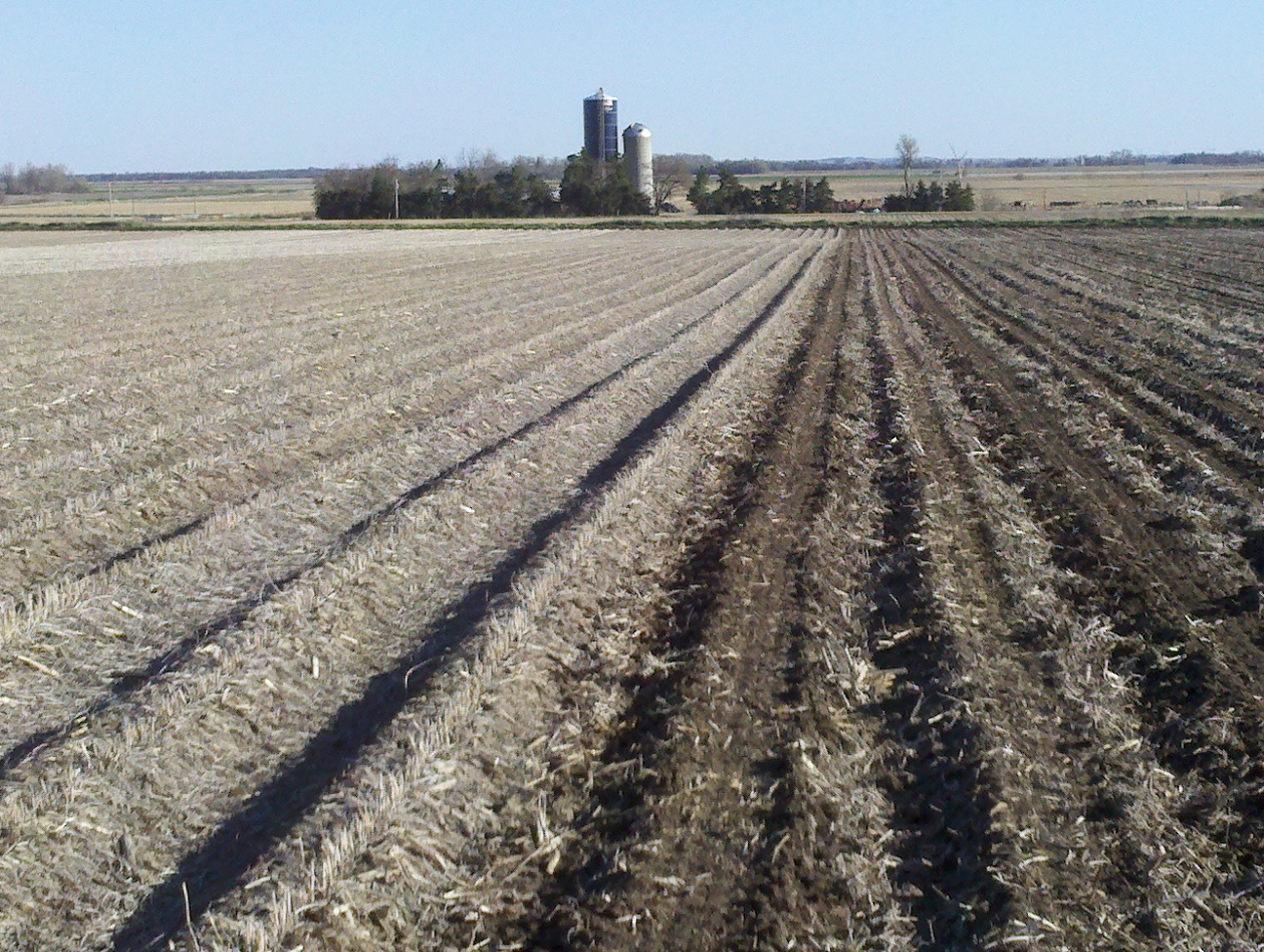
This is looking back while ridging with the adapted cultivator. The picture below is looking ahead over the hood. The corn has almost shaded the entire row now. It would have already shaded the row except we received some hail in June which slowed the corn down.
This is the corn today. As you can see the corn is growing rapidly. This is only one week after ridging. Now the corn is adding a leaf per day and 4-6 inches of height.
We normally would be irrigating like crazy by July 4, but we are much wetter than normal. The soil is fully saturated and we will wait for a week or two before starting to irrigate. The more we can keep the pumps turned off the lower the expenses will be.
Saturday, July 9, 2011
Time Flies in the Summer!
Wednesday, June 8, 2011
Corn is growing!!
I haven't kept writing as I wanted to. Just too tired or busy at night. This week the temperatures finally warmed up, all the way to 98! The corn is loving these temps and bright sunshine and is growing fast.
This picture was taken on May 23. The corn was planted on May 3 and in 20 days the corn was up and starting it's second leaf. This was ridge planted in corn stubble.
This is a different field taken on June 7. This was ridge planted in soybean stubble on April 29. If you look close you can spot some old corn stalks from 2009 still on the surface. I was spraying this field with a tank mix of herbicides. On our corn I use a generic glyphosate herbicide and an atrazine based preemergent herbicide. I use the mix to avoid herbicide resistant weeds. I needed to spray the corn before it reached 11.5 inches and you can see that I was pushing it a little. Much of our corn grew 3-4 inches from Sunday to Wednesday.
Next comes applying nitrogen fertilizer and spraying soybeans. We will also cultivate the corn next week after it's fertilized. Oh and we also cut our first cutting of alfalfa to bale next week too. Might be a bit busy.
This picture was taken on May 23. The corn was planted on May 3 and in 20 days the corn was up and starting it's second leaf. This was ridge planted in corn stubble.This is a different field taken on June 7. This was ridge planted in soybean stubble on April 29. If you look close you can spot some old corn stalks from 2009 still on the surface. I was spraying this field with a tank mix of herbicides. On our corn I use a generic glyphosate herbicide and an atrazine based preemergent herbicide. I use the mix to avoid herbicide resistant weeds. I needed to spray the corn before it reached 11.5 inches and you can see that I was pushing it a little. Much of our corn grew 3-4 inches from Sunday to Wednesday.
Next comes applying nitrogen fertilizer and spraying soybeans. We will also cultivate the corn next week after it's fertilized. Oh and we also cut our first cutting of alfalfa to bale next week too. Might be a bit busy.
Thursday, May 26, 2011
Row Stalker
Finally getting around to posting pictures of our Row Stalker. As you can see there are two disc per row that run against each other. They cut off the root ball from the previous year and throw it out of the way. This machine runs best at high speeds, 10-15 mph. Usually our teenage workers get to run this as they love the speed.We finished planting soybeans May 17 followed by our four varieties ornamental popcorn and two varieties of broom corn. This is in addition to the three varieties of large Indian corn that were planted earlier.
I'll have another blog about this hobby gone bad later as they start to grow.
We did receive a light rain the evening of May 17 (0.65") and then a good soaking rain May 24-25 (3.25"). Now we need some sunshine.
Sunday, May 1, 2011
Planting 2011
I finally started planting corn on Thursday, April 28. It took all afternoon to get the planter and tractor all hooked up and all the wires and hoses in the right places. One hang up was the tractor guidance system was not talking to the planter module. Technology is great when it works, a pain when it doesn't.
My Trimble guidance system is quite busy during planting. It steers the tractor, runs and controls a fertilizer injection pump, runs and controls the seed drive, turns row clutches on and off and logs everything on a data card. The seed population is adjusted automatically to match a prescription that I made. I plant more seeds per acre on the high yielding ground and fewer seeds on the lower yielding ground. Also some hybrids like high populations and some hybrids like lower populations.
The row clutches are new this year. They help cut seed costs and raise yields by not double planting on the ends or edges of fields. I plant one pass or two on the bottom of most fields first. When I plant the field, the guidance system knows when I cross into what was already planted and shuts the rows off. When all are off I can lift out of the ground and turn around. On square fields this is not a big deal. I could come pretty close by hand. The real benefit comes on the many odd shaped fields that I farm. Sometimes one side of the planter is off for several yards before the other side is done planting.
These are some of the pictures I've taken this year planting corn. The first two are ridge-planting into a field that was soybeans last year. These fields are very mellow and we plant directly on the ridge from last year with no other tillage.
The next two are ridge-planting into a field that was corn last year and will be again this year. I am on a corn-corn-soybean rotation on most of our fields. Before the planter we ran a machine called a Row Stalker. I can't find any photos in our files (I know they are there somewhere), but I will post them as soon as I can get some new shots. The Row Stalker has two discs that run against each other and they cut off the top 2 inches of the ridge left from last year. This cuts off the root balls from last year's corn. Those roots are very tough and I need to get them out of the way for this years corn crop. I then plant on the ridge.
The picture on the right is no-till planting into an alfalfa field that has been sprayed with a herbicide to kill the alfalfa. We used to use several tillage passes to break up the field, which took a lot of diesel fuel and dried out the soil. This method works much better.
I should be half done planting corn by Monday evening. Most of our fields are now dry enough to plant, although we did find a few wet spots Saturday.
My Trimble guidance system is quite busy during planting. It steers the tractor, runs and controls a fertilizer injection pump, runs and controls the seed drive, turns row clutches on and off and logs everything on a data card. The seed population is adjusted automatically to match a prescription that I made. I plant more seeds per acre on the high yielding ground and fewer seeds on the lower yielding ground. Also some hybrids like high populations and some hybrids like lower populations.
The row clutches are new this year. They help cut seed costs and raise yields by not double planting on the ends or edges of fields. I plant one pass or two on the bottom of most fields first. When I plant the field, the guidance system knows when I cross into what was already planted and shuts the rows off. When all are off I can lift out of the ground and turn around. On square fields this is not a big deal. I could come pretty close by hand. The real benefit comes on the many odd shaped fields that I farm. Sometimes one side of the planter is off for several yards before the other side is done planting.
![]() |
| Planting into soybean stubble. |
![]() |
| Planting into soybean stubble. |
![]() |
| After Row Stalking, before planting. |
![]() |
| Planting on the old corn ridge. |
The next two are ridge-planting into a field that was corn last year and will be again this year. I am on a corn-corn-soybean rotation on most of our fields. Before the planter we ran a machine called a Row Stalker. I can't find any photos in our files (I know they are there somewhere), but I will post them as soon as I can get some new shots. The Row Stalker has two discs that run against each other and they cut off the top 2 inches of the ridge left from last year. This cuts off the root balls from last year's corn. Those roots are very tough and I need to get them out of the way for this years corn crop. I then plant on the ridge.
![]() |
| Planting into alfalfa sod. |
The picture on the right is no-till planting into an alfalfa field that has been sprayed with a herbicide to kill the alfalfa. We used to use several tillage passes to break up the field, which took a lot of diesel fuel and dried out the soil. This method works much better.
I should be half done planting corn by Monday evening. Most of our fields are now dry enough to plant, although we did find a few wet spots Saturday.
Friday, April 29, 2011
Planting!!
Finally started planting on April 28. Still too wet in some fields. This is ridge planted into soybean stubble without any other tillage.
Published with Blogger-droid v1.6.8
Saturday, April 16, 2011
Rain/snow, is spring coming?
Friday we received 1.6 inches of precip. mostly as rain, but also had 4 inches of wet slushy snow. Plus we has 40-50 mph winds all day. It all melted by 4pm but was very nasty at 8 am. C slid into the ditch driving to school, as did several of her rural classmates. The slush and the 50 mph winds were not good to the younger drivers.
Hopefully that will be the last blast of winter. I'm ready for spring and planting crops!!
Friday, April 15, 2011
Spring Farm Work
It's raining outside so I am catching up in the office today, which includes writing this post. I have pushed this off for too long.
We ridge plant all of our crops, which means that we do no tillage in the spring. We do have other tasks to keep us busy though. First we apply dry fertilizer to the fields. We only apply what each field needs, based on soil fertility test done last fall by our agronomist. When we apply the fertilizer rate to an entire field I use a machine that looks much like a lawn fertilizer spreader. The nutrients we mostly apply with dry fertilizer is phosphorus, potassium, sulfur and zinc. Most of our nitrogen fertilizer is applied as a liquid, and most of that is put on during the growing season.
Many of our fields have been grid sampled, where our agronomist takes separate soil samples from small squares inside of the entire field. They may end up with 30-40 different soil fertility tests per field. Then they prescribe different amounts of fertilizer to each area. On these fields I hire our local coop to apply the dry fertilizer since they have the machine that can vary the dry fertilizer rates as they drive across the field. This saves money, fertilizer and improves yields; a win, win, win.
The next step for us is to shred the corn stalks left from last year. We do rent our corn stalks to a neighbor with cows to graze during the winter. The cows do eat quite a bit of the refuse left from last year's crop, but they do not eat the corn stalks. They need to be chopped up to make cultivating easier later in the year. We use a Rhino shredder that shreds 6 rows at a time.
Then we spray all of our fields with a herbicide package to kill winter annuals (dandelion, tansymustard, field pennycress and others) and stop early sprouting spring weeds. On fields going to corn we spray the herbicide mixture with a base of 32% liquid nitrogen. This heats up the herbicide mix (works faster) and gives the soon to be planted corn an early boost. Our sprayer covers 20 rows at a time and is 60 feet wide. Turning on ends of fields can be tricky if you don't watch what you are doing.
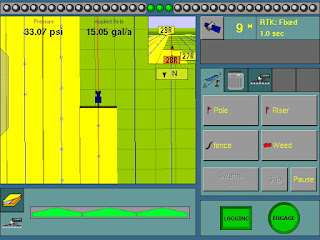
We use a Trimble guidance computer on all our tractors. This is a screenshot of me spraying a field. It keeps the tractor and sprayer on the right path and eliminates overlap. It also controls how much spray is going on the field. If I speed up or slow down it resets the valves so I put on exactly what I want, in this case, 15 gallons per acre (upper center of screen). It also turns the spray boom on and off on the ends, and if the field has a diagonal end it turns them on and off in sequence to avoid any more overlap than necessary.
That's it for today. When I start planting I'll write about that.
We ridge plant all of our crops, which means that we do no tillage in the spring. We do have other tasks to keep us busy though. First we apply dry fertilizer to the fields. We only apply what each field needs, based on soil fertility test done last fall by our agronomist. When we apply the fertilizer rate to an entire field I use a machine that looks much like a lawn fertilizer spreader. The nutrients we mostly apply with dry fertilizer is phosphorus, potassium, sulfur and zinc. Most of our nitrogen fertilizer is applied as a liquid, and most of that is put on during the growing season.Many of our fields have been grid sampled, where our agronomist takes separate soil samples from small squares inside of the entire field. They may end up with 30-40 different soil fertility tests per field. Then they prescribe different amounts of fertilizer to each area. On these fields I hire our local coop to apply the dry fertilizer since they have the machine that can vary the dry fertilizer rates as they drive across the field. This saves money, fertilizer and improves yields; a win, win, win.
The next step for us is to shred the corn stalks left from last year. We do rent our corn stalks to a neighbor with cows to graze during the winter. The cows do eat quite a bit of the refuse left from last year's crop, but they do not eat the corn stalks. They need to be chopped up to make cultivating easier later in the year. We use a Rhino shredder that shreds 6 rows at a time.
Then we spray all of our fields with a herbicide package to kill winter annuals (dandelion, tansymustard, field pennycress and others) and stop early sprouting spring weeds. On fields going to corn we spray the herbicide mixture with a base of 32% liquid nitrogen. This heats up the herbicide mix (works faster) and gives the soon to be planted corn an early boost. Our sprayer covers 20 rows at a time and is 60 feet wide. Turning on ends of fields can be tricky if you don't watch what you are doing.
We use a Trimble guidance computer on all our tractors. This is a screenshot of me spraying a field. It keeps the tractor and sprayer on the right path and eliminates overlap. It also controls how much spray is going on the field. If I speed up or slow down it resets the valves so I put on exactly what I want, in this case, 15 gallons per acre (upper center of screen). It also turns the spray boom on and off on the ends, and if the field has a diagonal end it turns them on and off in sequence to avoid any more overlap than necessary.
That's it for today. When I start planting I'll write about that.
Subscribe to:
Posts (Atom)