Another one of the many regulations that affect farmers these days is the SPCC or Spill Prevention Control and Countermeasure. While it went into effect several years ago most farmers were ignoring this regulation because the EPA was looking at other industries and not ag. Not anymore.
This regulation states that if you have storage capacity of more than 1320 gallons of fuel and oil on your farm you need to have a spill plan in place and some type of control facility. There are many acceptable ideas and you can self-certify your operation, but like all federal rules and regulations, it takes an engineer and an attorney to understand the rules.
There is a chance Congress may change the rules of the SPCC to exempt farmers, but we decided to go ahead and meet the current rules. One reason is that we are close to groundwater and a creek is less than 100 yards away. This spring we hired an engineering firm to develop a plan and design a control structure for our farm. Most of the plan is "boilerplate" and is identical to many other plans. but it fulfills the rules of the feds.
We decided to build a steel tank with a poly liner to contain our fuel storage tanks. It was easier to install than we thought it would be, the worst was figuring out what went where.
Our plan called for a 12" containment depth, but the side sheets were 33" tall, so we dug a trench with our backhoe to lower them.
We were really dreading installing the liner, but it was remarkably easy. They sent plenty extra and we were able to keep the roll fairly square while unrolling it.
We trenched the electric line from the old site to the new site. Helps having an electrician live next door.
This is our finished site. We will repaint the 2 older tanks white again. The white paint helps reduce vaporization of the fuel we store.
Saturday, August 17, 2013
Sunday, July 7, 2013
Sounds and sights of farming
This week I was reminded again of why I love to be a farmer in Nebraska. We started irrigation season and the first week is a lesson is patience and remaining calm. While I want to get every well running the first day, there seems to always be problems here or there that delay the process.
After we get started we have to change our sets twice a day, ideally 12 hours apart. For me that means starting mornings at 6:00-6:30 and finishing the day around 6:00-7:00.
I love the morning sets the best. It is cool and the wildlife is still out and about. Everyday I get to see
deer, turkeys, pheasant, quail, meadowlarks, doves, bunnies, etc. running and playing. while walking along the pipelines I can hear the various birdsongs, the creak of branches and even the far off train horns going through crossings several miles away. It is a very peaceful relaxing time.
I love being a farmer.
Sunday, June 16, 2013
Sidedressing Corn
This week the corn is really starting to take off. We are cultivating the first time to loosen the soil and kill any weeds that escaped the herbicide. Next step is sidedressing the corn. No we are not putting clothes on them. Sidedressing means adding fertilizer to the growing crop, right beside the plant.
We use liquid fertilizer on our farm, but there are other options like anhydrous ammonia and dry fertilizer. This is a picture of the rig we use. It cover 14 rows, 36" apart or 42 feet. We can travel around 10 mph, so it doesn't take long to finish a field. The yellow tank holds 1500 gallons of fertilizer.
This is a shot of the coulter that runs along the side of the corn. It runs about 2-3 inches deep . Behind the coulter is an injection nozzle to squirt the fertilizer into the slot left by the coulter. This ensures the fertilizer will be absorbed by the soil and then the plant and not volatilized into the air.
We use liquid fertilizer on our farm, but there are other options like anhydrous ammonia and dry fertilizer. This is a picture of the rig we use. It cover 14 rows, 36" apart or 42 feet. We can travel around 10 mph, so it doesn't take long to finish a field. The yellow tank holds 1500 gallons of fertilizer.
Every field gets a different amount of fertilizer. We base the amount we apply on soil tests. This year we are applying anywhere from 15 to 45 gallons of 32% nitrogen per acre now. We are also adding 5 gallons per acre of thiosulfate. This mix equals 60-170 pounds of nitrogen per acre.
Looking down the rows. This corn was planted on May 6, 2013. The previous crop was also corn. We use a three-year rotation. Two years of corn and one year of soybeans. This field has been cultivated once and will be cultivated again soon to form the ridges we gravity irrigate with.
On fields that are irrigated with a pivot or underground drip we do not need to cultivate and we practice no-till on them.
Friday, May 3, 2013
Will summer ever get here?
The calendar says May 3, but the weather says March or February. Here in Lexington we missed the snow for the most part. While we had light snow falling for several hours, there was no accumulation due to warm soil. But it got cold last night, down to 26 this morning.
Eastern Nebraska, Iowa, Minnesota and other states got a lot of snow yesterday and today. Iowa and Minnesota got up to 15 inches. That is a lot of snow to melt and then more time to dry and warm up the soil. I have no idea when they will start planting in those areas.
We started planting corn late Monday night on the Batie farm. We put the planter on about 3:00, but had lots of settings to make and electronic issues to straighten out. With the new guidance system we had to rewire the planter as well. Trying to get the guidance system to talk to the planter and the fertilizer pump was interesting. By 7:00 we had it so I could go, not perfectly, but could go.
Tuesday I went pretty hard, after I moved a flowmeter to make the guidance system happy. Still had a few glitches, but was not stopping for that. The picture is notilling corn into soybean stubble. I went until 10:30 Tuesday night and then the rain started. I was moving to a new field and tried planting into corn stubble. With the moisture all I did was rake up the stalks.
We ended up with 0.75" of rain/sleet. Nice rain but oh so cold. I am a little concerned with the cold rain and what it will do to the germination of the corn seeds already planted. There is some research that when corn seeds absorb cold water it hurts germination. Only time will tell.
With the rainout I made an appointment with Hope, our precision farming specialist, to come out and finetune some guidance glitches and tweak the fertilizer pump. Now I think I am ready to go again, whenever it dries out and warms up.
This is not the latest I have started planting. I well remember 1987 when we started the morning of the Kentucky Derby. Why do I remember that day? That was the year I smashed the pinky finger of my left hand. Ten days after I smashed it I got Kenny started planting corn that Saturday morning and then I went into the hospital to have half of the finger amputated. I watched the Derby while laying down in the recovery room.
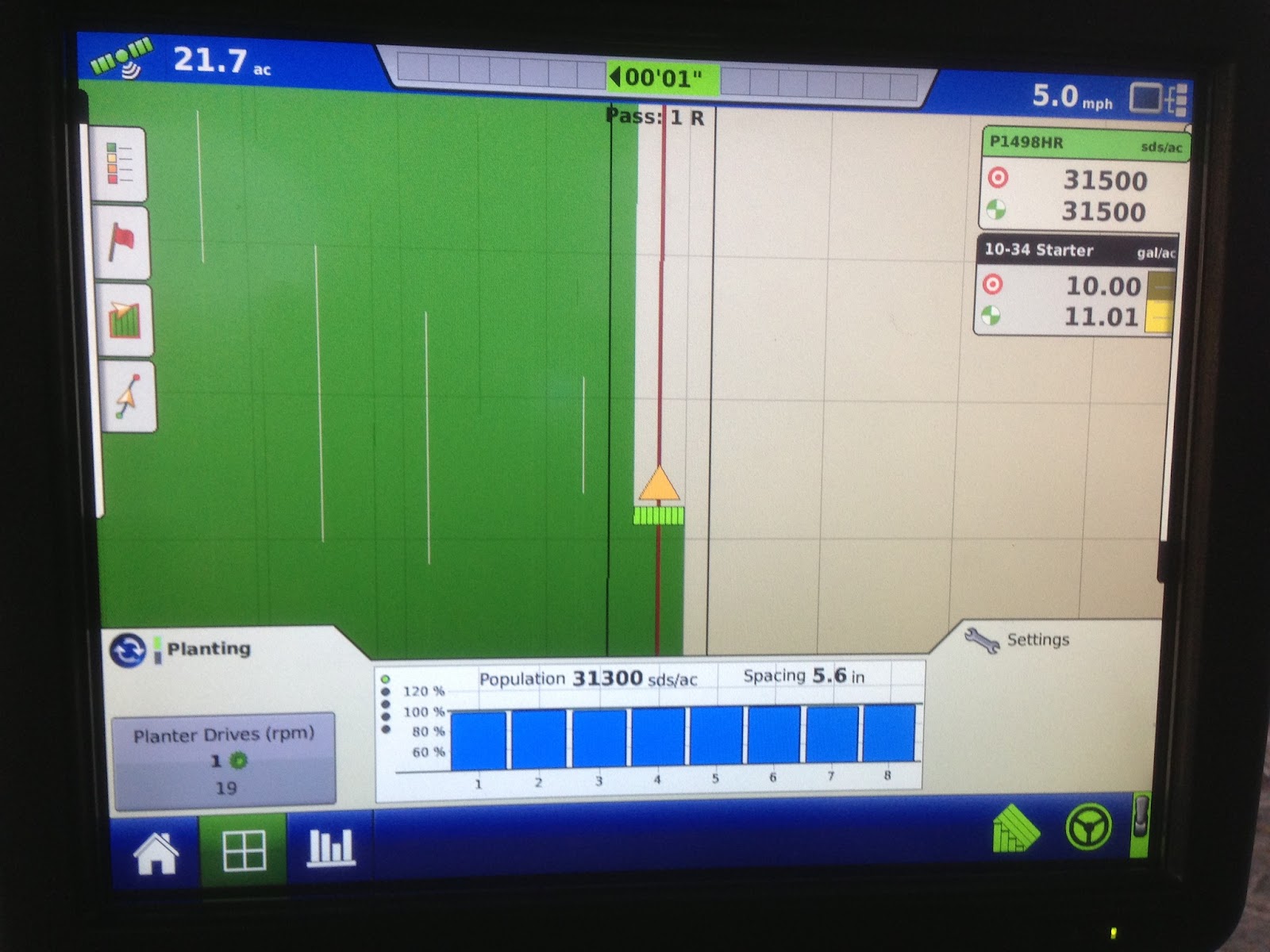
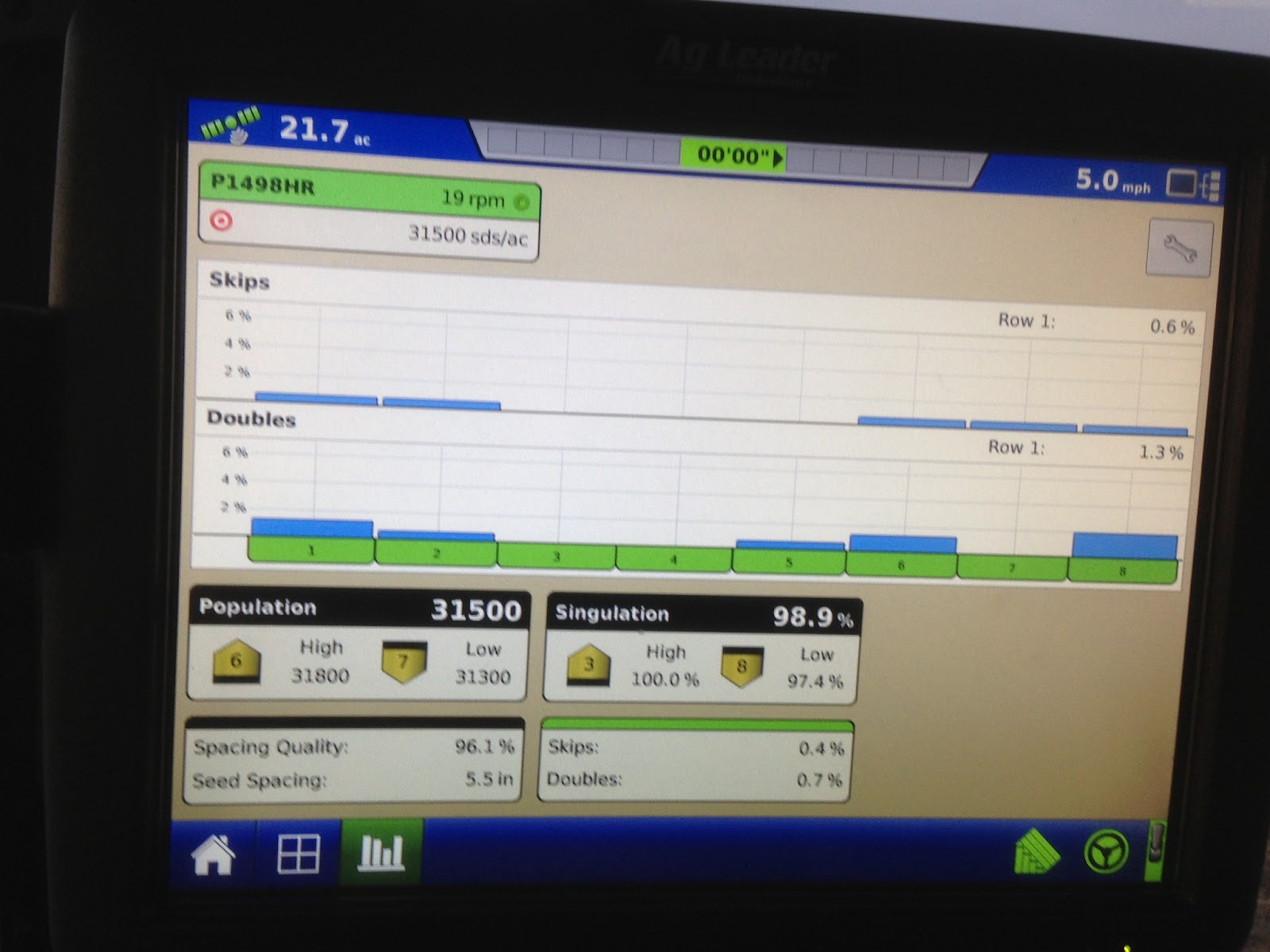
Here are some pictures of the Integra monitor doing it's thing while planting. I have lots of choices of what I want to monitor while planting. I can watch population, spacing, singulation, skips, doubles, prescriptions, etc.
Eastern Nebraska, Iowa, Minnesota and other states got a lot of snow yesterday and today. Iowa and Minnesota got up to 15 inches. That is a lot of snow to melt and then more time to dry and warm up the soil. I have no idea when they will start planting in those areas.
We started planting corn late Monday night on the Batie farm. We put the planter on about 3:00, but had lots of settings to make and electronic issues to straighten out. With the new guidance system we had to rewire the planter as well. Trying to get the guidance system to talk to the planter and the fertilizer pump was interesting. By 7:00 we had it so I could go, not perfectly, but could go.
Tuesday I went pretty hard, after I moved a flowmeter to make the guidance system happy. Still had a few glitches, but was not stopping for that. The picture is notilling corn into soybean stubble. I went until 10:30 Tuesday night and then the rain started. I was moving to a new field and tried planting into corn stubble. With the moisture all I did was rake up the stalks.We ended up with 0.75" of rain/sleet. Nice rain but oh so cold. I am a little concerned with the cold rain and what it will do to the germination of the corn seeds already planted. There is some research that when corn seeds absorb cold water it hurts germination. Only time will tell.
With the rainout I made an appointment with Hope, our precision farming specialist, to come out and finetune some guidance glitches and tweak the fertilizer pump. Now I think I am ready to go again, whenever it dries out and warms up.
This is not the latest I have started planting. I well remember 1987 when we started the morning of the Kentucky Derby. Why do I remember that day? That was the year I smashed the pinky finger of my left hand. Ten days after I smashed it I got Kenny started planting corn that Saturday morning and then I went into the hospital to have half of the finger amputated. I watched the Derby while laying down in the recovery room.
Here are some pictures of the Integra monitor doing it's thing while planting. I have lots of choices of what I want to monitor while planting. I can watch population, spacing, singulation, skips, doubles, prescriptions, etc.Monday, April 22, 2013
Chickens
As far as I know there have always beens chickens on our farm. I grew up feeding the chickens, gathering eggs and helping to pluck the broilers when they were ready. After getting married I discovered Barb also grew up doing the same thing. When we swapped houses with my parents to move onto the home place she inherited my mother's chickens.
Feeding time. We take the feed away from the chicks at night so they don't overgorge themselves. The broilers will actually eat themselves to death if the feed is not limited. In the morning they are starved.
We use heat lamps to keep the chicks warm. The first couple of days we try to keep their house at 90 degrees. Now we are shooting for 75 degrees. This shouldn't be an issue in late April, but not this year. It is supposed to get down to 26 tonight (April 22).

This is our freshly cleaned layer house. With the cold wet weather I helped scoop and haul the chicken litter out to the garden. We use shredded paper for litter. The hens love to scratch it around and it catches their waste and makes clean up fairly easy.
Our 10 hole layer box. This is where we want the hens to lay their eggs. The bottoms are sloped so the eggs roll out to the front. Some hens prefer to make their own nest and we have to go find them every day.
These are the eggs from 2 days of laying for our hens. You will notice the variety of colors including a few that are blue-green. These are from a special breed of chickens that lay eggs with a colored shell. The color of the shell makes no difference to the color of the egg inside.
We currently have a small flock of about 35 laying hens. Barb also raises 50 broilers every year. They are a fun hobby that keeps us and the neighbors in eggs and meat.
Since Barb is gone for a few days I get to take care of her hens and the chicks that will replace them this summer and fall. We currently have mostly red sex-linked hens, but a few years ago we had chickens of many breeds. Our daughters showed chickens in 4-H and they needed purebred chickens to show. As a result our hen flock was quite colorful and our eggs were also quite varied in color.
These chicks are about 3 weeks old. The little red and black chicks will be the new laying hens. The large white chicks are broilers. They will be ready to butcher in 4 more weeks. They are breed to grow very fast.
![]() |
Feeding time. We take the feed away from the chicks at night so they don't overgorge themselves. The broilers will actually eat themselves to death if the feed is not limited. In the morning they are starved.
We use heat lamps to keep the chicks warm. The first couple of days we try to keep their house at 90 degrees. Now we are shooting for 75 degrees. This shouldn't be an issue in late April, but not this year. It is supposed to get down to 26 tonight (April 22).
This is our freshly cleaned layer house. With the cold wet weather I helped scoop and haul the chicken litter out to the garden. We use shredded paper for litter. The hens love to scratch it around and it catches their waste and makes clean up fairly easy.
Our 10 hole layer box. This is where we want the hens to lay their eggs. The bottoms are sloped so the eggs roll out to the front. Some hens prefer to make their own nest and we have to go find them every day.
These are the eggs from 2 days of laying for our hens. You will notice the variety of colors including a few that are blue-green. These are from a special breed of chickens that lay eggs with a colored shell. The color of the shell makes no difference to the color of the egg inside.
Happy free range chickens. We have a large area for the hens to run around on. We have an electric fence about 6 inches from the ground to keep the dogs and other critters out and helps keep the chicken in. We also have a taller netting fence on the yard side as well. Sometimes we have to clip the feathers from one wing to keep the chickens from flying out.
Friday, April 19, 2013
Some Truths About Fertilizer
In the aftermath of the tragic fire and explosion in Texas I have heard many half-truths and some outright fallacies about fertilizer. Today I am trying to get the truth out.
First of all, fertilizer is an essential ingredient to modern commercial agriculture. Fertilizer contains concentrated elements that are needed for plants to grow and nitrogen, phosphorus and potassium are the most common. This same fertilizer mixture is also applied to most lawns and gardens across the country to keep them green and growing.
There are three basic forms of fertilizer, each with their own hazards and benefits. I will go over each in turn.
Anhydrous ammonia is the most concentrated form of fertilizer. Is is 82% nitrogen by weight. Anhydrous, as it is commonly known, is stored as a liquid under pressure in those long white tubes that look like a huge salami. At normal atmospheric pressure is is a gas. Farmers transport anhydrous from the plant to the farm in smaller white steel tanks on a trailer and each holds about 1000 gallons.
The benefit of anhydrous is that is is concentrated and requires fewer trips to town to purchase the fertilizer and fewer times refilling. It is usually the least expensive form of nitrogen fertilizer available. Twenty years ago most farmers used anhydrous as their primary form of nitrogen. Today many famers have switched because of the hazards involved.
Anhydrous ammonia can be dangerous if not handled carefully. It will not burn or explode, as has been reported. Since anhydrous ammonia is stored under pressure, if a valve or hose breaks the ammonia will spray into the atmosphere. It is not a poison, but anhydrous ammonia gets very, very cold when going from a liquid under pressure to a gaseous state. It will freeze whatever is in its path, including my father's leg many, many years ago.
Anhydrous ammonia also wants to join with water, that's what anhydrous means, no water. If released near a person the anhydrous ammonia will absorb the water in the eyes and mouth. Too much, too close and it will blind you. But it will not burn or explode and did not cause the Texas explosion.
Liquid fertilizer is a lower concentration of fertilizer stored and shipped in a liquid form. Most common liquid fertilizers used around here are 32-0-0 (32% nitrogen) and 10-34-0 (10% nitrogen and 34% phosphorus). Liquid fertilizer is gaining in popularity because the hazards are much smaller and it is easier to handle. It does require more trips to fertilize our fields.
The hazards of liquid fertilizer are the salts in the liquid. It will burn in a cut or if splashed into an eye. If spilled into a stream it will cause a fish kill, again by too much salt. It would not be the best thing to drink, but it is not a poison. Once again it will not burn or explode.
Dry fertilizer is the medium concentration of fertilizer. It is identical to what is commonly spread on lawns and gardens. When examined closely dry fertilizer resembles little balls. There are many forms of dry fertilizer, some of the most common are 46-0-0 (urea; 46% nitrogen), 11-52-0 (monoammonium phosphate; 11% nitrogen and 52% phosphorus), 0-0-60 (potash; 60% potassium) and 34-0-0 (ammonium nitrate; 34% nitrogen).
These dry ingredients are mixed to create the desired levels of each main ingredient. Dry fertilizer is gaining in usage around here with current prices. It works well with variable rate fertilization, where we only apply how much fertilizer is needed in each area of a field.
Of those listed above none are really dangerous except one. Most are non-flammable and non-explosive. The one exception is ammonium nitrate (34-0-0). It is the main component of ANFO and was used to blow up the Federal Building in Oklahoma City. By itself ammonium nitrate is not going to explode, it needs other components, namely a carbon source and heat and pressure. The carbon source for the Oklahoma City bomb was diesel fuel. Heat and pressure were supplied by a small explosion.
If you want to read of a really bad explosion, Google the Texas City harbor explosion that destroyed the town. This explosion happened on a couple of ships in 1947. Ammonium nitrate fertilizer in cotton bags (carbon) were in a ship that caught fire. Standard practice at the time to extinguish a ship's fire was to seal the compartment and pump in steam (heat and pressure). BOOM.
So what happened in West, Texas this week? We'll probably never know. From reading the accounts of the firefighters and extrapolating from them my guess is this: A fire started in the retail plant. The firefighters thought they had it out. After smoldering for a while it reignited. Some reports say there were propane tanks nearby which would provide the carbon. The wooden building would also provide the carbon. The fire is the source of the heat and pressure.
Can this happen in Lexington or your local town? I would love to say absolutely not, but there is a small chance. All employees of fertilizer plants know how dangerous the products are that they handle every day and they treat them carefully. Reflect that over the 60 plus years of using commercial fertilizer there are only a couple of very bad explosions that have occurred by accident. Here in Lexington the fertilizer plant is in an industrial area and not near any residences.
Final word is that fertilizer is essential for modern agriculture. While there are hazards involved, fertilizer can be handled safely and carefully. Accidents can happen anywhere anytime. We prepare for the worst and expect the best.
Saturday, April 13, 2013
Those Magic GPS Boxes
One of the latest innovations in agriculture is a spin-off from the military, Global Positioning Satellites (GPS). Many of you may have a Garmin or something similar in your car, or a GPS enabled iPad that will give you directions. Our tractors now sport a box that makes your Garmin look like a toy. Your Garmin or iPad is accurate to about 10 feet, plenty good while driving a car. Our GPS devices are accurate to less than 1 inch, called real time kinematic (RTK) accuracy. This is so we can plant, cultivate and spray without driving over the plants. A base station is needed to get RTK accuracy. To start with we rented the RTK signal from our dealer.
Our GPS devices will take over steering the tractor through the field, once you have set a pattern. If you want straight rows, no problem. Just set an A-B line from one end to the other and your entire field will be perfect. If you have a curve to follow and want the whole field to follow that durve, no problem. Just set a curved A-B line.
Steering is just the beginning. These devices can also be configured to do many other functions in your tractor or combine. These include, but are not limited to, driving the seed shaft on a planter, turning seed row clutches on and off, driving the fertilizer pumps, turning spray booms on and off, regulating how much fertilizer or spray is applied, changing the amount of seed, fertilizer or spray applied on the go - automatically, measuring yield or altitude, installing drainage tile, etc. All of the above are being done on our farm now.
The first use of a GPS system on our farm was yield mapping with a combine mounted device. We got cool maps that showed us what yielded great and what didn't. We already knew where most of these areas were, but it sure looked cool. Next step was to put those maps to work.
We entered the field of GPS control four years ago when we bought our current planter. We opted not to purchase the standard planter monitor, but put the money toward a GPS device that would control the planter AND auto-steer the tractor. We chose the Trimble FMD brand of monitor. At the time they were way out in front on guidance hardware and had pretty good application controls. Unfortunately they were not the best at customer service.
The first year we were content with auto-steer and planter controls. Later in the summer we added an EZ-Boom to control a sprayer. The sprayer had an automatic shut-off feature so if we sprayed the edge of a field first it would shut the booms off as they got to the already applied area. No more double spraying and no skips. Things went pretty well; then after the initial setup, there were tear your hair out issues.
We disced down all our previous ridges in our fields so we could start from scratch. Over the years of ridge-planting our corn fields, many rows had gotten crooked and the guess rows (the space between one pass and the next) were not exact. Unfortunately the old ridges still had an influence and cause us some issues yet today, pulling the cultivators from side to side.
We traded tractors to get a second tractor with an FMD monitor in it. We were set. Who could want anything more? Well, me. We added a coulter fertilizer machine to apply fertilizer while the crop was growing, so that meant another EZ-Boom.
And then we purchased another tractor and added a guidance system to it. Unfortunately Trimble had moved on to a new platform, FMX, that wasn't totally compatible with the old system. This meant that tractor could follow the same A-B lines set up by the other monitors for cultivation, but could not run the planter and could only run a sprayer with extra cabling.
Then I started writing prescriptions for each field to vary the amount of seed and fertilizer applied. I used the cool yield maps as guidance. On the great yielding areas I increased the seed populations and fertilizer to boost the yields even higher. On the lower yielding areas I lowered the seed populations and fertilizer to cut costs. Many of those areas won't yield as much no matter what.
Then we added row clutches to the planter seed drives so we could control each row separately. This works great when you have end rows. Plant the end rows first and then the field. When the planter comes to the end rows, the rows just shut off, one by one. No double planting, and no skips.
In 2012 we purchased a tile plow (see Tile Plow 3/12/12). To control the tile plow we moved our GPS receiver from the roof of the tractor to the mast of the tile plow. We used a unique monitor for tiling, that was all it could do. It worked pretty well, but we had some issues with the base station being 8-10 miles away. So last fall I bought a used portable base station and things went great.
Meanwhile last summer we started having issues with our first FMD. Every so often, usually when we hit a bump, the screen would go black. After the first couple waves of panic, I used the Fonzy approach and tapped the monitor with my pliers. Luckily it came back on. It got more frequent and we knew we had to do something before the 2013 season.
While shopping around we discovered that Ag Leader had purchased the company who made our tile plow. They would allow us full retail price to trade in our tile-only monitor for an new Integra monitor that would do everything. I jumped.
Of course that meant we had to rewire the tractor, rewire the planter, learn a new system, etc. And to make it more fun we decided to switch tractors around so that the Integra went into the tractor with the FMX, and the FMX went into the tractor with the bad FMD. The installing tech loved me (insert sarcasm).
Oh, and we also decided to make our portable base station into a permanent base station. With our own base I did not need to pay our dealer for that signal. However, to get an Integra (from Ag Leader), and FMX and FMD (both from Trimble) to talk to the same base radio (older Trimble) was ... let's say, interesting. They had three different GPS receivers and radios on the roof and Ag Leader uses a different radio setup. I ended up using the radio receiver from the bad FMD tied into the new Integra and downgraded all of the systems to the same version and it works. I don't know how many hours the dealer's precision farming expert spent figuring out all the cables and hookups, but she is amazing. We are still working out kinks in the new system, but are well on the way.
Now I'm set, again... perhaps. I'm excited about a new system that senses the crop to vary the fertilizer automatically without a prescription, and I'm sure there is something else new out there just waiting to catch my interest.
Subscribe to:
Posts (Atom)