Sunday, October 13, 2013

Soybean Harvest


This has been my view for the last several days and a few more to come. We started soybean harvest on October 1 and have logged eight days so far in the combine seat. I have a few more to go as we still have 320 acres or so to go. We can combine about 120 acres of soybeans a day if we can go all day. The picture above was in a field where the beans are planted in rows that are ridged for gravity irrigation. If you look close you will see green leaves still on the plants. This made combining very tough.

We also have many fields where the soybeans are drilled and there are no ridges. On these you can go whatever direction you want to go. GPS guidance systems make this job much easier and faster. We can always keep a full swath. When I have to steer by hand I always leave a couple of feet on the end of the head so I don't leave strips of beans uncut.

When the sun goes down you keep right on cutting, until the humidity comes up and stops you cold. One night I was tooling along at 3.5 mph at one end and when I finished the round I was crawling at 2 mph. The soybeans had gone from 9.5% moisture to 12% moisture in just one round.

We unload the combine on the go, saving time. A great day is where I can start combining in the morning and not stop the combine or get out of the cab, except for calls of nature, until night. Combines cost so much money (a new combine and head will cost around $500,000) that you can't afford the down time. Also we want to get the crops out as fast as possible as soon as they are ready for harvest. Nothing good can happen to them in the field once they are ripe.
Climate controlled cabs are not a luxury during harvest. This a shot of the same grain cart the same day, just going the opposite direction. The wind was blowing all the dust from the back of the combine up to the front. Soybean dust is very scratchy and not good in the lungs.

Here are three of our trucks used to haul the crops away to market. We run a fleet of five trucks. One has already left for the elevator and one was busy hauling hogs (a sideline business). Only three of the five are my trucks. The others belong to a neighbor. We share the combine and harvest crew to reduce our costs. It has worked out well for both of us.


When soybeans harvest is finished, hopefully this week, we will move immediately to corn harvest. This will take longer because we have more corn acres to harvest. I will post again then.

Sunday, September 15, 2013

Wild Fruit


One of the benefits of farming many small fields bordered by creeks, canals and ditches is the wild fruit that we get to enjoy. In central Nebraska there are 4 varieties of wild fruit that we may get to harvest, emphasis on the MAY.
Most years we get to pick at least one and usually 2 or 3, but it is a rare year where we get to harvest all four crops. Late spring freezes, hail, insects and birds all take their toll. This year was one of the rare years and I picked all four.
The first fruit that ripens is the mulberry. Mulberry trees are kind of a pest and we don't like them around the yard. When birds eat the berries their poo turns an awful purple color that stains terrible. These mulberries grow on Buffalo Creek and one tree is a white mulberry. It is even sweeter than a normal mulberry. Makes great pies. They were ripe the first of July.


The next fruit that ripens are chokecherries. They are small purple to black berries that will really make you pucker when eaten raw. Cooked, however, with enough sugar and they are wonderful. They make great jelly and even better pies. The problem with pies is pitting all the seeds out. Most of the cherry is pit and not much left over for pie. I picked the chokecherries the middle of July.

Next up on the fruit bandwagon are wild grapes. They usually ripen about mid August. Wild grape vines are hard to find and I'm not telling where mine are. Wild grapes vines don't bear every year. Sometimes they take a few years off, so you never know which vine will have fruit on it. Sometimes they climb trees and the fruit is 20 feet in the air. This year I was laying on the ground cutting the wild grapes.


The final fruit of the year are the wild plums. This is the fruit by which Lexington got its original name Plum Creek. Plum thickets grow all over and are ripe about September 1. This year they are plentiful and are not ripening all at once. As I write there are still ripe plums out there. Wild plums are not purple like domestic but are red/orange.

Barb has processed all this wonderful goodness to jams, jellies and pies. The wild fruits make a nice change of pace from the domestic fruit that we buy or pick. The wild fruit just has a unique flavor that can't be described. 

Saturday, September 7, 2013

Irrigation 2013

It's September and I've gotten lazy again. Since we are almost finished with irrigation I ought to tell you we have been doing this summer.


Farming in the middle of Nebraska we need to irrigate if we hope to raise a normal crop every year. The picture at left shows the difference between irrigated and dryland.

We have two different water sources, surface and ground. Surface water is diverted out of a river or stream and then transported to the fields by canals or pipe. Our water comes from the Platte River and is brought to our farm by the Dawson County Canal. It is the third oldest canal in Nebraska and was dug with horses and mules about 1894.

 At right you are looking down the canal north of our house. It is already half the size it was at the river 12 miles upstream. The Platte River falls 6 feet every mile it moves east. The canals were designed to fall 1 foot every mile. This way the canal moves away from the river as it moves east.
Ground water is water taken from the ground (simple huh?). Our ground water comes from the Ogallala Aquifer, one of the largest fresh water aquifers in the world. We are very fortunate to have a very thick water supply that is also close to the surface. We hit water about 10 feet down and the water bearing sand and gravel is about 200 feet thick. This a picture of our newest well, drilled 3 years ago. We do have limitations on drilling new wells, they can only replace old wells.

 We use three different ways to deliver the water to the plants in the field now. My father used two others in previous decades, but newer methods are more efficient. The "oldest" method we currently use is gated pipe. This is either aluminum or plastic pipe that is 8-10" in diameter. There are rectangular holes cut in one side and plastic gates inserted to plug the holes.


Every summer around July 1 we have to string out the pipe on the ends of the fields. I usually recruit some high school kids to help. The pipes are 30' feet long and we put out about 5 miles of pipe so that is a lot of pipe.

This a picture of the water coming out of the open gates. When we are irrigating we have to go to each field and open a new set of rows and close the old rows twice a day. We use old golf putters to tap the gates open and closed. Saves a lot of sore backs.

We use gated pipe on both surface and ground water. Most fields we have a pump on the surface water to pressurize it for the gated pipe. Some fields have enough gravity drop to work without a pump.


Each fall we must remember to flush the gated pipe that is on surface water. There is sediment in the water that settles out in the pipe. The picture at right is just after I pulled the plug. It will flush for several hours before the water starts running clear. If we don't the pipes will have enough mud in them to make it almost impossible to pick up in the fall.


After the last irrigation (and flush) we pull the pipes apart and then find another crew of strong backs to pick all the pipe back up and pile it for next year.

We started using gated pipe in 1975 and until a few years ago that was all we used. Then I purchased a couple of center pivot irrigation systems (left). The look like a pipe in the air with wheels underneath. One end is fastened to a pivot point and the other end moves around the field in a circle. They have sprinklers on them similar to ones in your yard, put more precise.

A new center pivot system is about $75,000 to $100,000 depending on what you add to the package. Normally they need little daily attention, other than to make sure they are still running. We have ours set up to send a text message to our phone if something happens to it. We also have an app to control the pivot from wherever we are. They are more efficient in using water than the gated pipe and take much less labor. Much of the land previously irrigated with gated pipe is being converted to pivots in our area if they fit the field. One downside is that pivots irrigate a circle in a square field so there are corners that will be dryland or will have to be irrigated another way.

The newest irrigation technology is subsurface drip irrigation (SDI). It has been used in orchards and other high value crops for several years, but is now finding a foothold in rowcrops here. I installed this system 3 years ago and am very happy. It is about twice as expensive as a full center pivot on a per acre basis, but if your field is small, rectangular or irregular shaped, it may be about the same price per acre.

This picture shows the valves that control which sections of the field get water. I am currently adding a computer controller to my system so that it can be controlled remotely.

Normally we finish irrigating by Labor Day, but not this year. We will be irrigating until September 14 at least. The crops got behind with some cool weather in August and are not mature yet. If we stop irrigating too soon the plants die early and the yield drops off dramatically.

Saturday, August 17, 2013

Preventing Spills

Another one of the many regulations that affect farmers these days is the SPCC or Spill Prevention Control and Countermeasure. While it went into effect several years ago most farmers were ignoring this regulation because the EPA was looking at other industries and not ag. Not anymore.

This regulation states that if you have storage capacity of more than 1320 gallons of fuel and oil on your farm you need to have a spill plan in place and some type of control facility. There are many acceptable ideas and you can self-certify your operation, but like all federal rules and regulations, it takes an engineer and an attorney to understand the rules.

There is a chance Congress may change the rules of the SPCC to exempt farmers, but we decided to go ahead and meet the current rules. One reason is that we are close to groundwater and a creek is less than 100 yards away. This spring we hired an engineering firm to develop a plan and design a control structure for our farm. Most of the plan is "boilerplate" and is identical to many other plans. but it fulfills the rules of the feds.

We decided to build a steel tank with a poly liner to contain our fuel storage tanks. It was easier to install than we thought it would be, the worst was figuring out what went where.


Our plan called for a 12" containment depth, but the side sheets were 33" tall, so we dug a trench with our backhoe to lower them.
We were really dreading installing the liner, but it was remarkably easy. They sent plenty extra and we were able to keep the roll fairly square while unrolling it. 

We trenched the electric line from the old site to the new site. Helps having an electrician live next door.

This is our finished site. We will repaint the 2 older tanks white again. The white paint helps reduce vaporization of the fuel we store.

Sunday, July 7, 2013

Sounds and sights of farming

This week I was reminded again of why I love to be a farmer in Nebraska. We started irrigation season and the first week is a lesson is patience and remaining calm. While I want to get every well running the first day, there seems to always be problems here or there that delay the process.

After we get started we have to change our sets twice a day, ideally 12 hours apart. For me that means starting mornings at 6:00-6:30 and finishing the day around 6:00-7:00.

I love the morning sets the best. It is cool and the wildlife is still out and about. Everyday I get to see
deer, turkeys, pheasant, quail, meadowlarks, doves, bunnies, etc. running and playing. while walking along the pipelines I can hear the various birdsongs, the creak of branches and even the far off train horns going through crossings several miles away. It is a very peaceful relaxing time.

I love being a farmer.

Sunday, June 16, 2013

Sidedressing Corn

This week the corn is really starting to take off. We are cultivating the first time to loosen the soil and kill any weeds that escaped the herbicide. Next step is sidedressing the corn. No we are not putting clothes on them. Sidedressing means adding fertilizer to the growing crop, right beside the plant. 

We use liquid fertilizer on our farm, but there are other options like anhydrous ammonia and dry fertilizer. This is a picture of the rig we use. It cover 14 rows, 36" apart or 42 feet. We can travel around 10 mph, so it doesn't take long to finish a field. The yellow tank holds 1500 gallons of fertilizer.


Every field gets a different amount of fertilizer. We base the amount we apply on soil tests. This year we are applying anywhere from 15 to 45 gallons of 32% nitrogen per acre now. We are also adding 5 gallons per acre of thiosulfate. This mix equals 60-170 pounds of nitrogen per acre.

 This is a shot of the coulter that runs along the side of the corn. It runs about 2-3 inches deep . Behind the coulter is an injection nozzle to squirt the fertilizer into the slot left by the coulter. This ensures the fertilizer will be absorbed by the soil and then the plant and not volatilized into the air.
Looking down the rows. This corn was planted on May 6, 2013. The previous crop was also corn. We use a three-year rotation. Two years of corn and one year of soybeans. This field has been cultivated once and will be cultivated again soon to form the ridges we gravity irrigate with.


On fields that are irrigated with a pivot or underground drip we do not need to cultivate and we practice no-till on them.

Friday, May 3, 2013

Will summer ever get here?

The calendar says May 3, but the weather says March or February. Here in Lexington we missed the snow for the most part. While we had light snow falling for several hours, there was no accumulation due to warm soil. But it got cold last night, down to 26 this morning.

Eastern Nebraska, Iowa, Minnesota and other states got a lot of snow yesterday and today. Iowa and Minnesota got up to 15 inches. That is a lot of snow to melt and then more time to dry and warm up the soil. I have no idea when they will start planting in those areas.

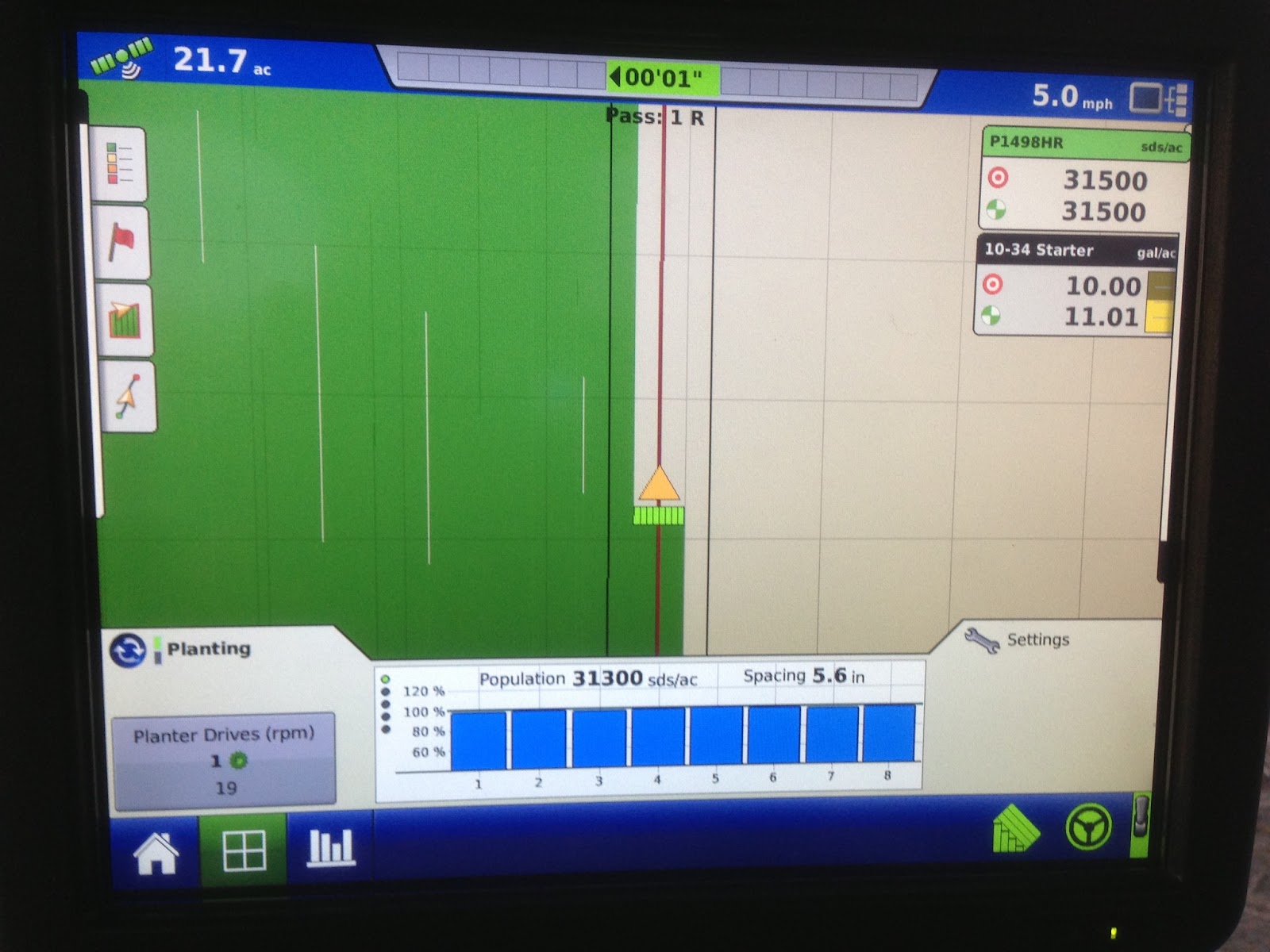
We started planting corn late Monday night on the Batie farm. We put the planter on about 3:00, but had lots of settings to make and electronic issues to straighten out. With the new guidance system we had to rewire the planter as well. Trying to get the guidance system to talk to the planter and the fertilizer pump was interesting. By 7:00 we had it so I could go, not perfectly, but could go.

Tuesday I went pretty hard, after I moved a flowmeter to make the guidance system happy. Still had a few glitches, but was not stopping for that. The picture is notilling corn into soybean stubble. I went until 10:30 Tuesday night and then the rain started. I was moving to a new field and tried planting into corn stubble. With the moisture all I did was rake up the stalks.


We ended up with 0.75" of rain/sleet. Nice rain but oh so cold. I am a little concerned with the cold rain and what it will do to the germination of the corn seeds already planted. There is some research that when corn seeds absorb cold water it hurts germination. Only time will tell.

With the rainout I made an appointment with Hope, our precision farming specialist, to come out and finetune some guidance glitches and tweak the fertilizer pump. Now I think I am ready to go again, whenever it dries out and warms up.

This is not the latest I have started planting. I well remember 1987 when we started the morning of the Kentucky Derby. Why do I remember that day? That was the year I smashed the pinky finger of my left hand. Ten days after I smashed it I got Kenny started planting corn that Saturday morning and then I went into the hospital to have half of the finger amputated. I watched the Derby while laying down in the recovery room.

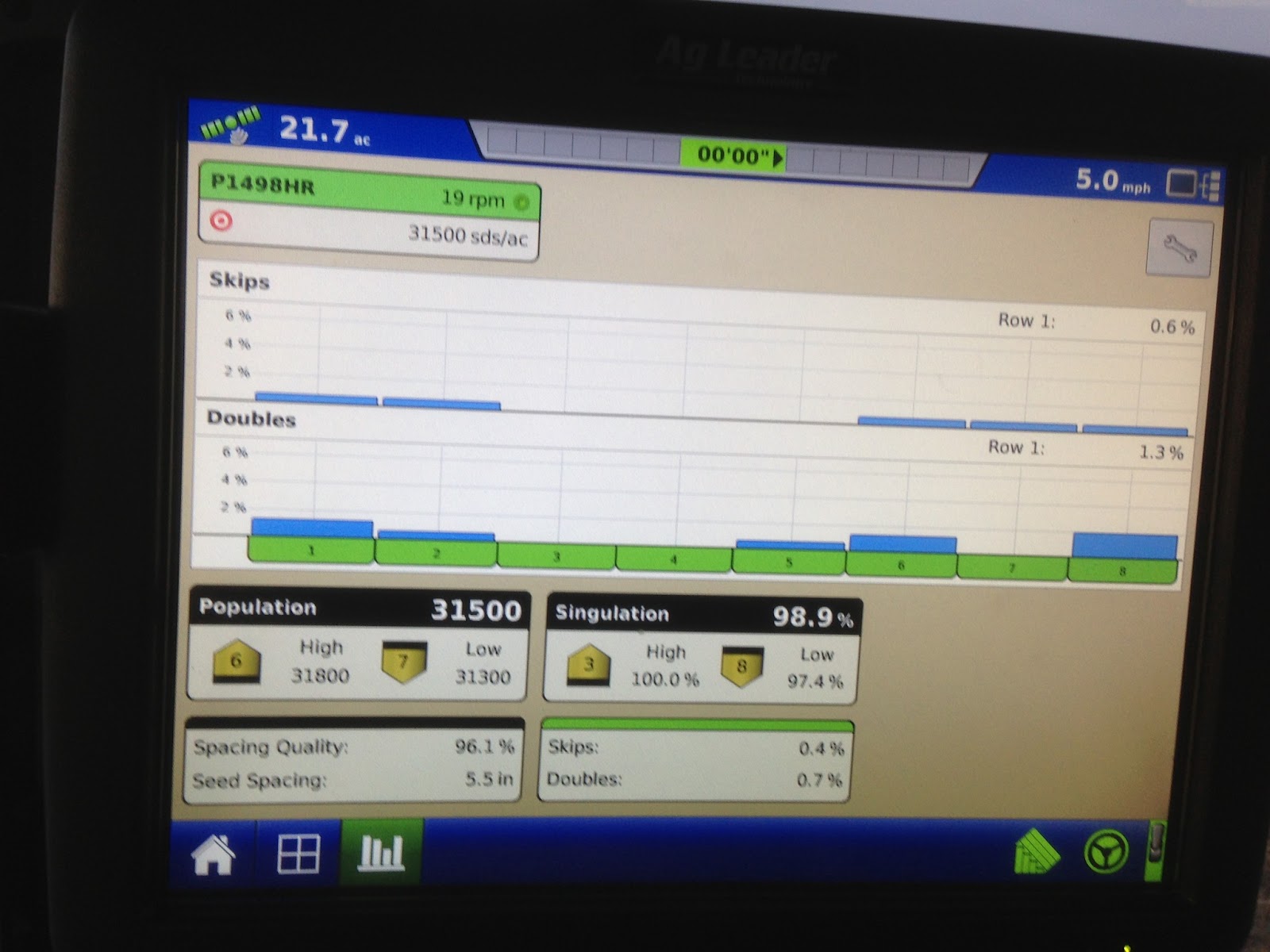
Here are some pictures of the Integra monitor doing it's thing while planting. I have lots of choices of what I want to monitor while planting. I can watch population, spacing, singulation, skips, doubles, prescriptions, etc.