Showing posts with label GPS. Show all posts

Sunday, April 23, 2017

Not Your Father's Farm Anymore

While planting corn in Nebraska and chatting via Facebook on my iPhone with my third cousin in California, it dawned on me how much agriculture has changed in the short 14 years since my father passed away.

My father started farming in 1937 after graduating from high school. At that time my grandfather was just starting to transition from horse power to tractor power. They farmed 240 acres, had a hired man and worked very hard.

During my father's career he was an early adapter. That is, he was rarely the first to use new technology or ideas, but was very early to add it to the farm after he saw it could work.

He adapted very early to using reduced tillage. I barely remember him using a plow for anything except mother's garden. Once he and Mom were on a trip through Iowa and while eating at a downtown cafe they overheard the farmers talking about "John Doe" who wasn't going to plow that year. They were debating whether his corn would even grow. Dad started laughing and told them he hadn't plowed in over 10 years and the corn would grow just fine. Of course he was still chiseling the ground and disking it twice before planting.

By the time of his retirement we had advanced to ridge planting, a form of minimum till. No-till was on the horizon. We had started electronically controlling fertilizer application. Genetically modified seed was just being introduced. But I think even he would be amazed at how much and how fast farming has changed.

File photo of a 730.
I remember as a youth helping Dad hook up to his planter. A John Deere 730 (53 horsepower, tricycle front end, no cab, 6 gears, hand clutch) to his 4-row planter with the 3-point hitch. He put in a seed plate and then filled each row with half to 2/3 of a bag of seed. The row markers were controlled with a rope. Then he'd go plant.

Today I run a New Holland T-8010 (210 horsepower, 19 gears that power shift, mechanical front wheel drive, duals, roomy quiet temperature controlled cab with stereo radio, all the tractor controls are switches that connect with electrical wires) with 300-gallon fertilizer tanks bolted on each side and the front. I'm hooked up to a Case 12-row 30-inch spacing planter with our Category 3 quick hitch 3-point that has a hydraulic top link. There are 8 hydraulic hoses connecting the planter to the tractor, 4 wiring harnesses, 4 air lines, and 2 fertilizer hoses. Each row will hold 2 bags of seed.

I have an Ag Leader Integra guidance computer mounted in the tractor cab that utilizes both the U.S. and Russian GPS satellites for steering the tractor in straight lines. We have no row markers anymore. It is also telling the planter how many seeds to drop and how much fertilizer to apply. The target seed population is changing as I drive through the field because we know which areas can produce more and which areas will produce less from ten years of yield data that is also GPS collected by the combine.

We use a disc or chisel only when we have to. Our ground is either ridge-tilled, if it is gravity irrigated, or no-till, if it is watered by pivot or subsurface drip irrigation. We figure every time we move the soil we are losing moisture and burning diesel fuel. If possible we let the worms and microorganisms in the soil do our work.

Dad started collecting soil samples from every field every year 35 years ago, including a deep sample for nitrates. He then fertilized each field according to the soil test. That was revolutionary then. Now we sample every 20 acres every year and grid sample every 5 acres every 5 years. Dad tested for nitrogen, phosphorus and pH. Now we test for nitrogen, phosphorus, potassium, sulfur, zinc, calcium, magnesium, sodium, hydrogen, pH and organic matter. We use the grid sample soil test to create maps that show which areas of the fields are high, medium or low in each nutrient. Then the agronomist makes up maps with variable amounts of several different fertilizers to correct the deficiencies.

Hybrid seed corn started while my Dad was farming. He would plant a good hybrid for 5-10 years until something better came along. All the seed I plant now is high tech GMO seed that is bred to kill insects that eat it and/or live through herbicides that will kill all other plants. I try new hybrids every year and a good hybrid might last only 3-4 years before it is outpaced by newer ones.

Irrigation has changed a great deal over the last 50 years. When Dad started farming he used open ditches and lath boxes to control the flow down each row. The lath boxes soon became siphon tubes. They would hire land levelers to move soil around so there was an even slope to the field. Instead of having ditches run through the field at several locations, they moved the ditches to one end and had longer runs. The open ditches started to become gated pipe while I was in high school, which meant much less labor was required to irrigate. Now I'm replacing the gated pipe with center pivots and subsurface drip irrigation. Again, greatly reducing labor requirements.

Dad would go out with a spade and dig down 6 inches and feel the soil to tell when to irrigate. Now we have electronic soil moisture probes that communicate via cell phone to the internet. I can read them on my cell phone and if needed I can start the well and turn the pivot on, all from my cell phone. If the pivot gets stuck or has a problem it sends me a text message.

All of Dad's corn went to feed his cattle in his feedlot. I had to close the feedlot in 2003, as it was too small to operate efficiently and was going to require some very expensive environmental updates to stay operating. Now much of the crop that will be harvested will be used to make ethanol for automotive fuel or will be fed to livestock somewhere else.

When returning from college I bought our first computer, a rare Apple III. (No, I don't have it anymore, traded it in.) It ran VisiCalc (forerunner to Excel), Basic (programming language) and some type of text editor. Now our farm runs on 2 iMacs in the office. Wife has a MacBook and both of us have iPads. I am writing this blog on my iPad while planting corn, since the guidance monitor will take care of most functions while going through the field.

What's next? We have been experimenting with cover crops for several years and are now making them a part of our rotation. Cover crops are planted after we harvest and will grow until the next season. We do not harvest them. Their purpose is to feed the soil microorganisms and worms, build organic matter and loosen up the soil. Now we realize the soil is full of living breathing organisms that can make or break our crops. There is more that we don't know than we do know about the interactions they have with our crops.

And then there is the changing role of women in agriculture. Women have always been partners with their husbands on the farm. Now many of the sales people, advisers, reporters and electronic techs I work with are women. Several days I come in and confess to my wife I have been texting other women all day. Since farming no longer requires as much brute force and is more mental, the number of women actively farming is increasing rapidly and that's a great thing.

Now we need many young people to enter agriculture. Some as farmers, but many more to fill the many occupations that we rely on every day. They do not need to have a farm background, although that helps. We need students who love science or math and enjoy the rural lifestyle. The University of Nebraska College of Agriculture and Natural Sciences (CASNR) is at record enrollment, but is looking for more students as they cannot graduate enough to fill the jobs available.

Hopefully some of you may know a young person who fits this niche. The world's population is predicted to rapidly increase and the amount of food we produce must increase even faster to stop famine in parts of the world.

Friday, May 3, 2013

Will summer ever get here?

The calendar says May 3, but the weather says March or February. Here in Lexington we missed the snow for the most part. While we had light snow falling for several hours, there was no accumulation due to warm soil. But it got cold last night, down to 26 this morning.

Eastern Nebraska, Iowa, Minnesota and other states got a lot of snow yesterday and today. Iowa and Minnesota got up to 15 inches. That is a lot of snow to melt and then more time to dry and warm up the soil. I have no idea when they will start planting in those areas.

We started planting corn late Monday night on the Batie farm. We put the planter on about 3:00, but had lots of settings to make and electronic issues to straighten out. With the new guidance system we had to rewire the planter as well. Trying to get the guidance system to talk to the planter and the fertilizer pump was interesting. By 7:00 we had it so I could go, not perfectly, but could go.

Tuesday I went pretty hard, after I moved a flowmeter to make the guidance system happy. Still had a few glitches, but was not stopping for that. The picture is notilling corn into soybean stubble. I went until 10:30 Tuesday night and then the rain started. I was moving to a new field and tried planting into corn stubble. With the moisture all I did was rake up the stalks.


We ended up with 0.75" of rain/sleet. Nice rain but oh so cold. I am a little concerned with the cold rain and what it will do to the germination of the corn seeds already planted. There is some research that when corn seeds absorb cold water it hurts germination. Only time will tell.

With the rainout I made an appointment with Hope, our precision farming specialist, to come out and finetune some guidance glitches and tweak the fertilizer pump. Now I think I am ready to go again, whenever it dries out and warms up.

This is not the latest I have started planting. I well remember 1987 when we started the morning of the Kentucky Derby. Why do I remember that day? That was the year I smashed the pinky finger of my left hand. Ten days after I smashed it I got Kenny started planting corn that Saturday morning and then I went into the hospital to have half of the finger amputated. I watched the Derby while laying down in the recovery room.

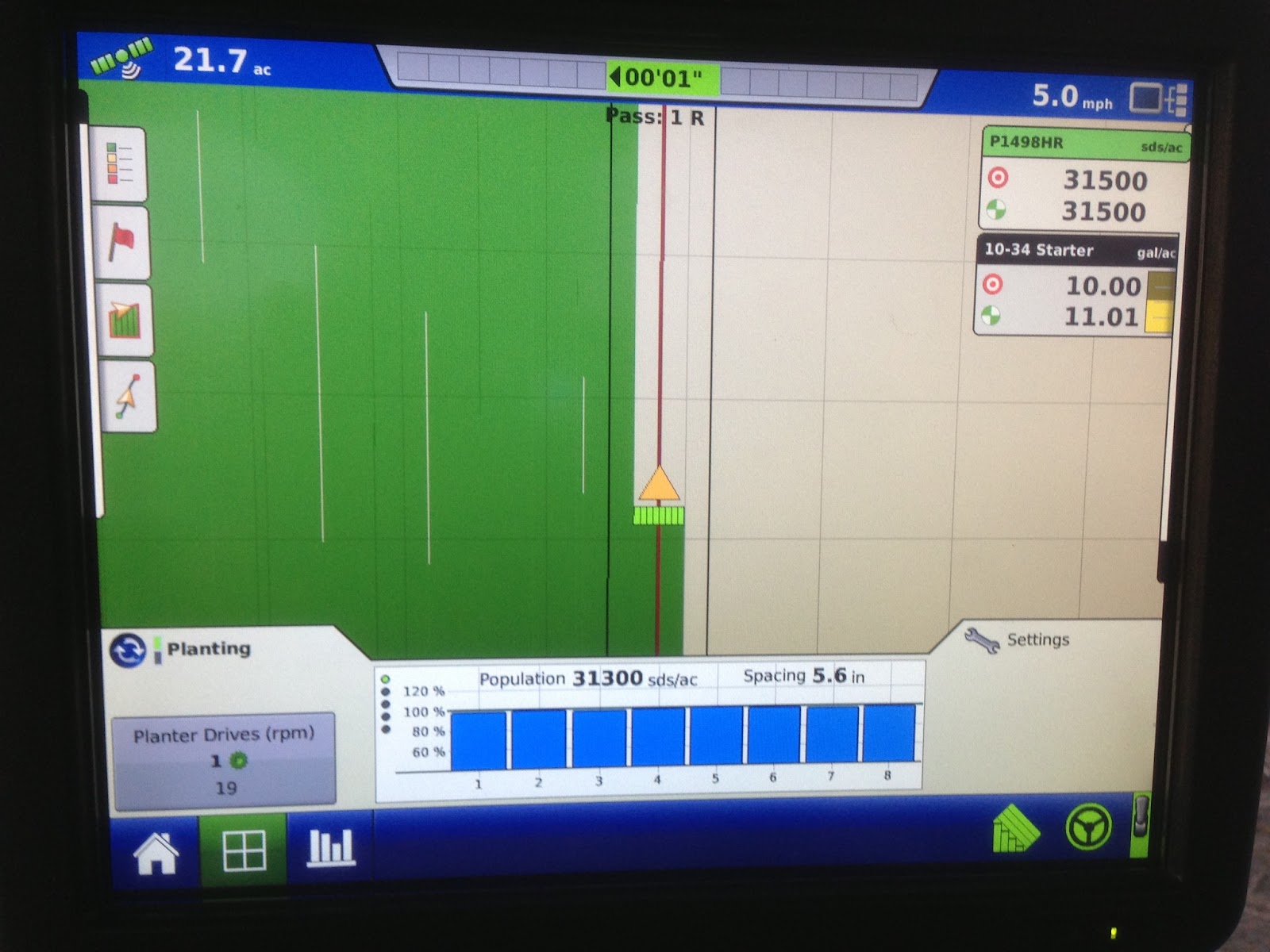
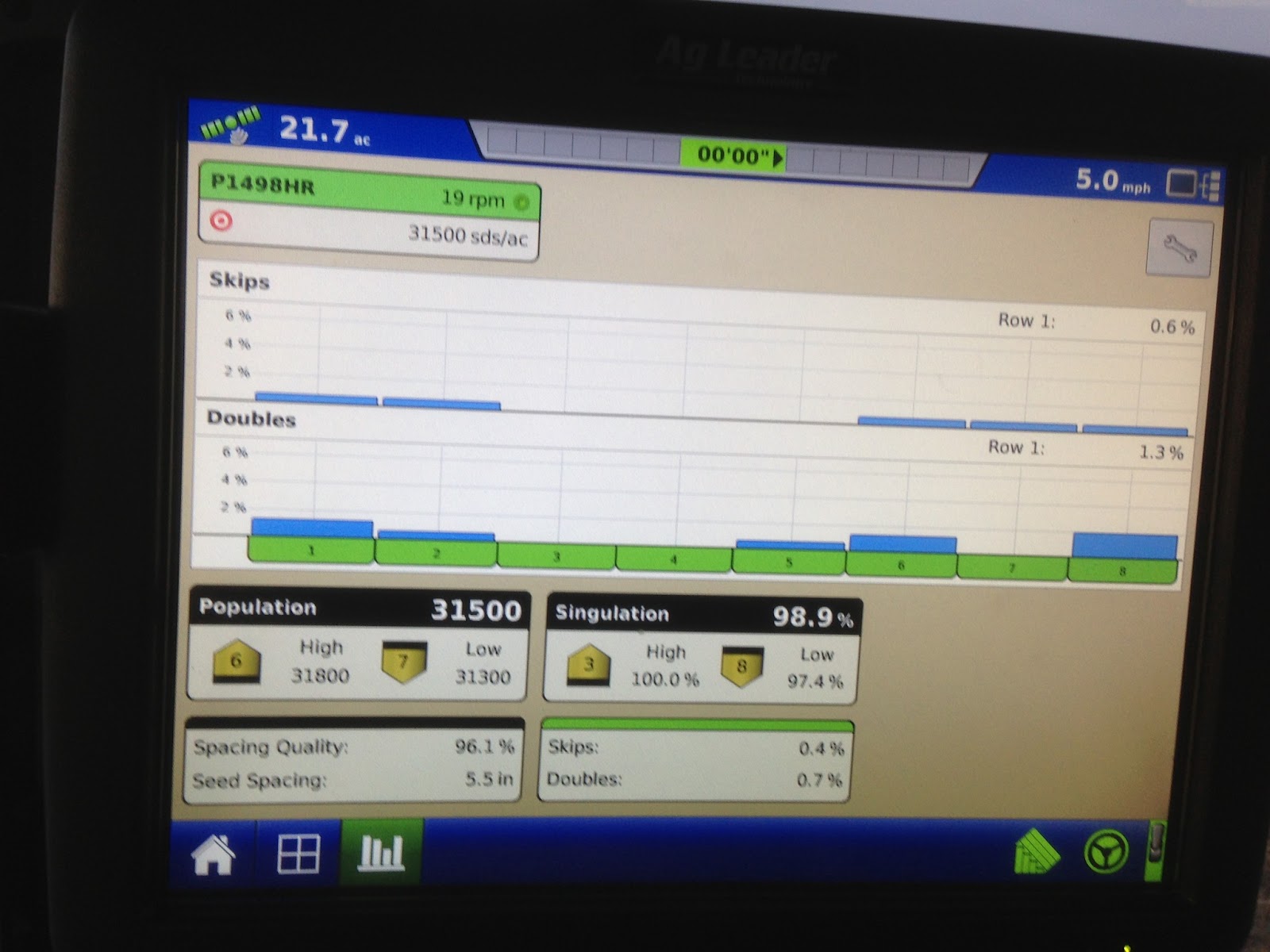
Here are some pictures of the Integra monitor doing it's thing while planting. I have lots of choices of what I want to monitor while planting. I can watch population, spacing, singulation, skips, doubles, prescriptions, etc.


Saturday, April 13, 2013

Those Magic GPS Boxes

One of the latest innovations in agriculture is a spin-off from the military, Global Positioning Satellites (GPS). Many of you may have a Garmin or something similar in your car, or a GPS enabled iPad that will give you directions. Our tractors now sport a box that makes your Garmin look like a toy. Your Garmin or iPad is accurate to about 10 feet, plenty good while driving a car. Our GPS devices are accurate to less than 1 inch, called real time kinematic (RTK) accuracy. This is so we can plant, cultivate and spray without driving over the plants. A base station is needed to get RTK accuracy. To start with we rented the RTK signal from our dealer.

Our GPS devices will take over steering the tractor through the field, once you have set a pattern. If you want straight rows, no problem. Just set an A-B line from one end to the other and your entire field will be perfect. If you have a curve to follow and want the whole field to follow that durve, no problem. Just set a curved A-B line.

Steering is just the beginning. These devices can also be configured to do many other functions in your tractor or combine. These include, but are not limited to, driving the seed shaft on a planter, turning seed row clutches on and off, driving the fertilizer pumps, turning spray booms on and off, regulating how much fertilizer or spray is applied, changing the amount of seed, fertilizer or spray applied on the go - automatically,  measuring yield or altitude, installing drainage tile, etc. All of the above are being done on our farm now.

The first use of a GPS system on our farm was yield mapping with a combine mounted device. We got cool maps that showed us what yielded great and what didn't. We already knew where most of these areas were, but it sure looked cool. Next step was to put those maps to work.

We entered the field of GPS control four years ago when we bought our current planter. We opted not to purchase the standard planter monitor, but put the money toward a GPS device that would control the planter AND auto-steer the tractor. We chose the Trimble FMD brand of monitor. At the time they were way out in front on guidance hardware and had pretty good application controls. Unfortunately they were not the best at customer service.

The first year we were content with auto-steer and planter controls. Later in the summer we added an EZ-Boom to control a sprayer. The sprayer had an automatic shut-off feature so if we sprayed the edge of a field first it would shut the booms off as they got to the already applied area. No more double spraying and no skips. Things went pretty well; then after the initial setup, there were tear your hair out issues.

We disced down all our previous ridges in our fields so we could start from scratch. Over the years of ridge-planting our corn fields, many rows had gotten crooked and the guess rows (the space between one pass and the next) were not exact. Unfortunately the old ridges still had an influence and cause us some issues yet today, pulling the cultivators from side to side.

We traded tractors to get a second tractor with an FMD monitor in it. We were set. Who could want anything more? Well, me. We added a coulter fertilizer machine to apply fertilizer while the crop was growing, so that meant another EZ-Boom.

And then we purchased another tractor and added a guidance system to it. Unfortunately Trimble had moved on to a new platform, FMX, that wasn't totally compatible with the old system. This meant that tractor could follow the same A-B lines set up by the other monitors for cultivation, but could not run the planter and could only run a sprayer with extra cabling.

Then I started writing prescriptions for each field to vary the amount of seed and fertilizer applied. I used the cool yield maps as guidance. On the great yielding areas I increased the seed populations and fertilizer to boost the yields even higher. On the lower yielding areas I lowered the seed populations and fertilizer to cut costs. Many of those areas won't yield as much no matter what.

Then we added row clutches to the planter seed drives so we could control each row separately. This works great when you have end rows. Plant the end rows first and then the field. When the planter comes to the end rows, the rows just shut off, one by one. No double planting, and no skips.

In 2012 we purchased a tile plow (see Tile Plow 3/12/12). To control the tile plow we moved our GPS receiver from the roof of the tractor to the mast of the tile plow. We used a unique monitor for tiling, that was all it could do. It worked pretty well, but we had some issues with the base station being 8-10 miles away. So last fall I bought a used portable base station and things went great.

Meanwhile last summer we started having issues with our first FMD. Every so often, usually when we hit a bump, the screen would go black. After the first couple waves of panic, I used the Fonzy approach and tapped the monitor with my pliers. Luckily it came back on. It got more frequent and we knew we had to do something before the 2013 season.

While shopping around we discovered that Ag Leader had purchased the company who made our tile plow. They would allow us full retail price to trade in our tile-only monitor for an new Integra monitor that would do everything. I jumped.

Of course that meant we had to rewire the tractor, rewire the planter, learn a new system, etc. And to make it more fun we decided to switch tractors around so that the Integra went into the tractor with the FMX, and the FMX went into the tractor with the bad FMD. The installing tech loved me (insert sarcasm).

Oh, and we also decided to make our portable base station into a permanent base station.  With our own  base I did not need to pay our dealer for that signal. However, to get an Integra (from Ag Leader), and FMX and FMD (both from Trimble) to talk to the same base radio (older Trimble) was ... let's say, interesting. They had three different GPS receivers and radios on the roof and Ag Leader uses a different radio setup. I ended up using the radio receiver from the bad FMD tied into the new Integra and downgraded all of the systems to the same version and it works. I don't know how many hours the dealer's precision farming expert spent figuring out all the cables and hookups, but she is amazing. We are still working out kinks in the new system, but are well on the way.

Now I'm set, again... perhaps.  I'm excited about a new system that senses the crop to vary the fertilizer automatically without a prescription, and I'm sure there is something else new out there just waiting to catch my interest.